

Are You Wasting Focus?
Most photographers are taught a simple and widely repeated instruction: focus on the subject. The camera confirms focus, the shutter is released, and the photograph is taken. In many situations this approach works well enough, which is why it persists.
However, this habit often prevents photographers from noticing how much usable sharpness is left unused in an image. This is not because of poor technique or misunderstanding, but because of how lenses and focus actually work. Every time a lens is focused, it produces a zone of acceptable sharpness that extends both in front of and behind the exact focus point. How that zone is used is a choice, even if it is usually made implicitly.
This article explores that unused sharpness through the idea of wasting focus. Rather than approaching the topic through formulas or technical charts, the aim here is to describe how focus can be placed more deliberately so that the available sharpness supports the image more effectively.
Technical concepts such as depth of field and hyperfocal distance are relevant to this discussion, but they are not the focus of it. The goal is not calculation, but intention.
How lenses distribute sharpness
A camera lens does not render only a single distance as sharp. Instead, it produces a continuous zone in which objects appear acceptably sharp to the human eye. The size of that zone depends on factors such as aperture, focal length, and subject distance, but the key point is that it always exists.
When you focus on a subject, the camera places that zone around the focus point. Some of the sharpness falls closer to the camera, and some falls further away. The camera does not evaluate whether that sharpness is being used effectively; it simply obeys the focus instruction it has been given.
If important elements of the scene lie outside that zone, they will appear soft. If the zone extends into areas of the scene that do not matter visually, that sharpness is effectively wasted.
Thinking in these terms reframes focus from a binary decision (“sharp” versus “not sharp”) into a resource allocation problem. You have a limited amount of sharpness available, and you decide where it is placed.
Why focusing on the subject is often inefficient
Focusing directly on the subject is a reasonable default, particularly for portraits, macro work, or fast-moving subjects where precision is critical. In those cases, the subject itself consumes most or all of the available sharpness, and there is little flexibility.
In many other situations, however, the subject is only one element of the image. There may be foreground details that provide context, background elements that establish place or scale, or multiple points of interest at different distances.
When focus is placed without considering these relationships, sharpness is often distributed unevenly relative to what matters in the frame. Foreground areas with little visual importance may be rendered very sharp, while background elements that contribute to the image’s meaning fall just outside acceptable focus.
This is not an error in technique. It is simply the result of not actively deciding how the available sharpness should be used.
From focusing to placing focus
A useful shift in thinking is to move from the question “What should I focus on?” to “Where should the sharpness be placed?”
The first question implies a single correct answer. The second acknowledges that sharpness occupies a range and that its placement affects the overall image.
Placing focus does not require abandoning autofocus or switching to manual focus in every situation. It requires awareness of how focus distance affects the distribution of sharpness through the scene.
Once this becomes part of your decision-making, familiar photographic situations often allow for more flexible and effective focus choices.
Close-range photography: people and pets
At close distances, depth of field is relatively shallow, especially at wider apertures. This makes focus feel precise and fragile, and for good reason. Small errors can result in visibly soft eyes or faces.
For portraits, focusing on the eye closest to the camera is often appropriate. However, even in close-range photography, sharpness distribution can sometimes be improved by reconsidering exact focus placement.
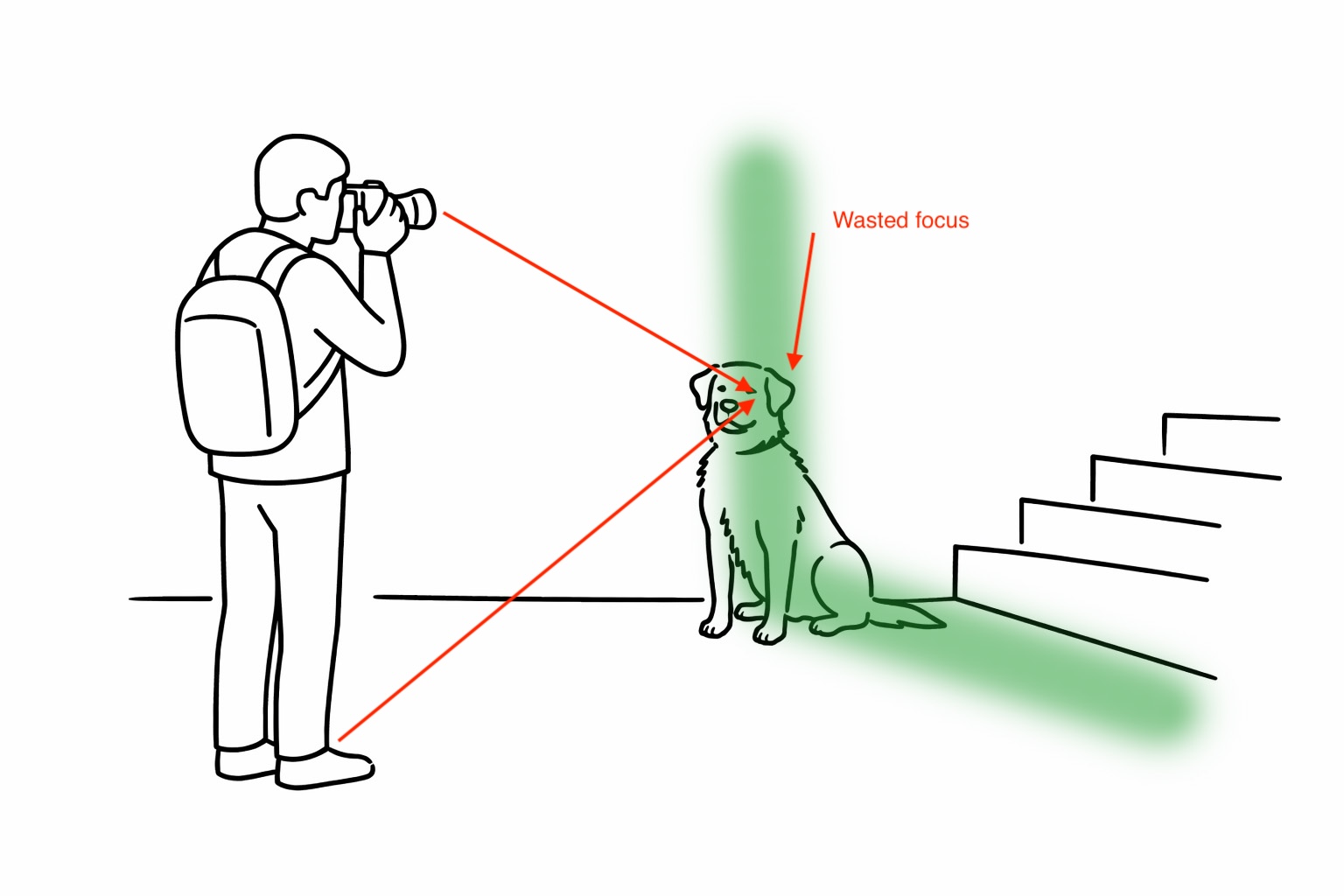
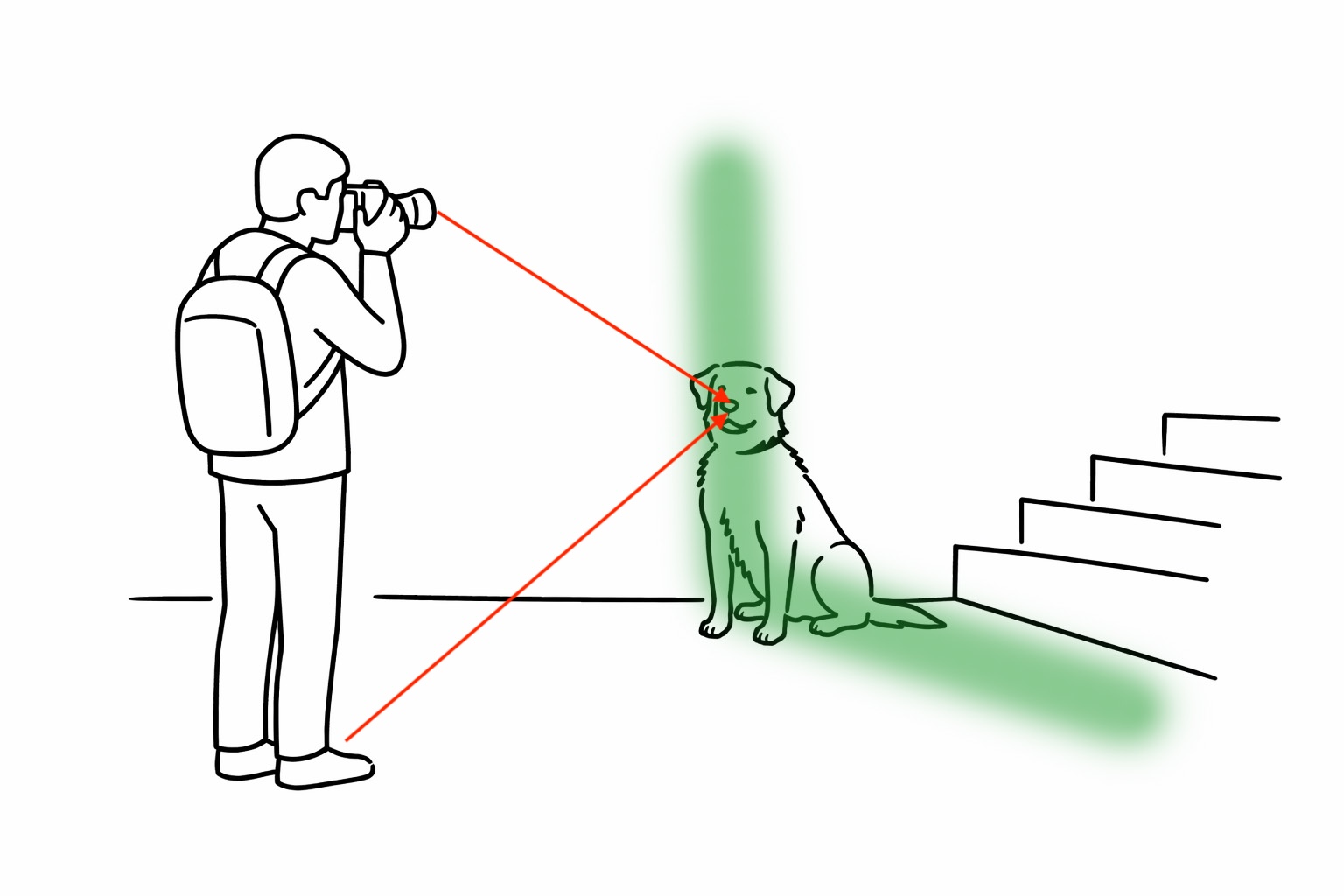
Consider a photograph of a dog sitting close to the camera. If focus is placed precisely on the eyes at a moderate aperture, the eyes may be sharp while the nose and ears fall slightly out of focus. If those elements are important to the image, some of the available sharpness is being wasted behind the eyes, where it has little visual value.
By stopping down slightly and placing focus marginally forward of the eyes, it is often possible to keep the eyes acceptably sharp while extending sharpness across more of the face. The image benefits from a more coherent rendering of the subject without requiring technical precision beyond what the camera already provides.
A similar principle applies to environmental portraits. Hands, clothing, or nearby objects can play a role in telling the story of the subject. If focus is locked too tightly on the eyes, sharpness may be wasted behind the subject while those elements soften unnecessarily.
The key point is not to abandon eye focus, but to recognise that “acceptable sharpness” can be sufficient, and that distributing it more evenly across important features can improve the image as a whole.
Wasted focus
Optimised focus
Middle-distance scenes: streets, buildings, wildlife
At moderate distances, depth of field increases, and the opportunity to waste focus grows with it. This is where many photographs lose potential clarity through habitual focus choices.
In street photography or architectural scenes, it is common to focus on the most obvious subject: a person, a doorway, a sign, or a central building. However, these scenes often rely on relationships between elements at different distances.
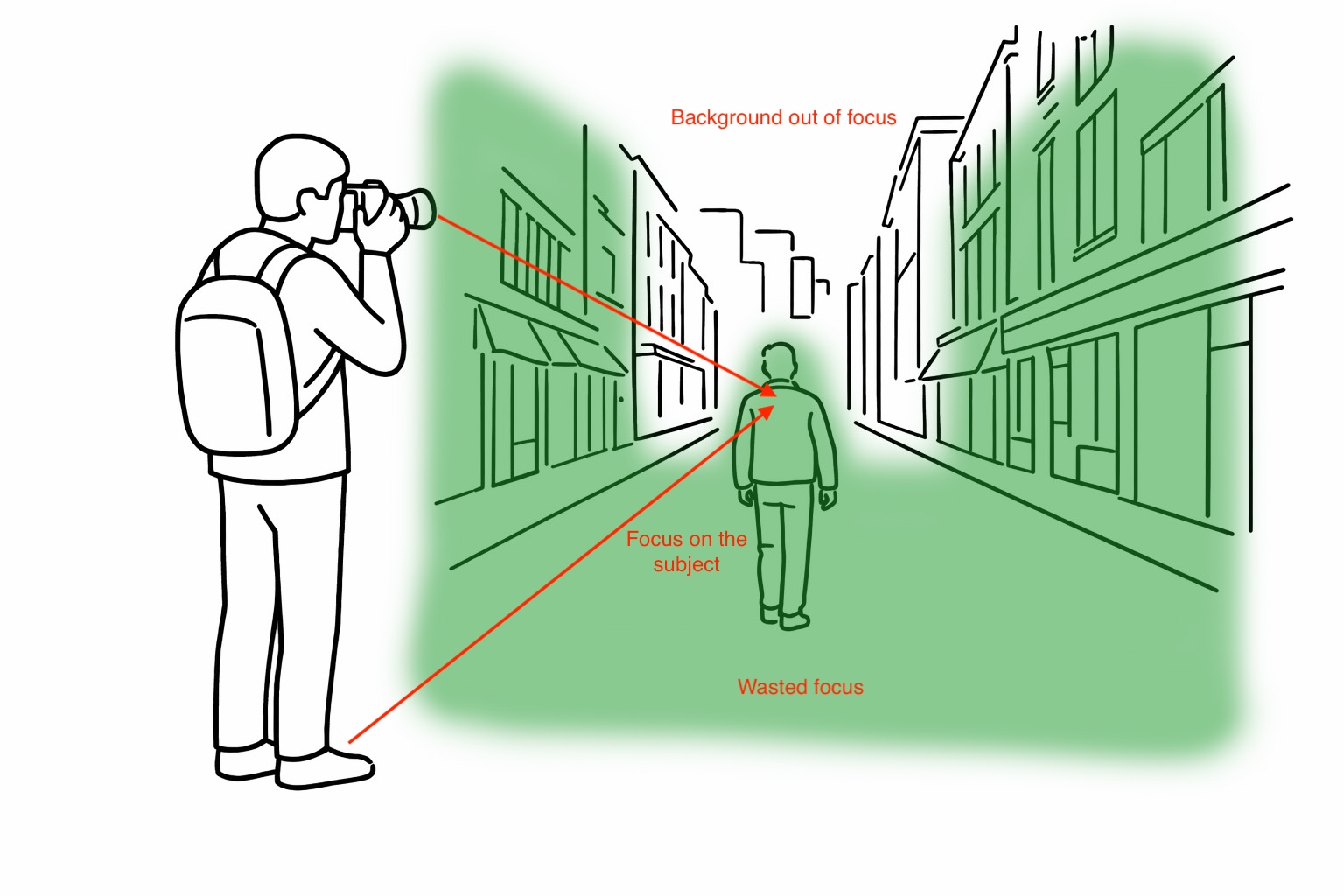
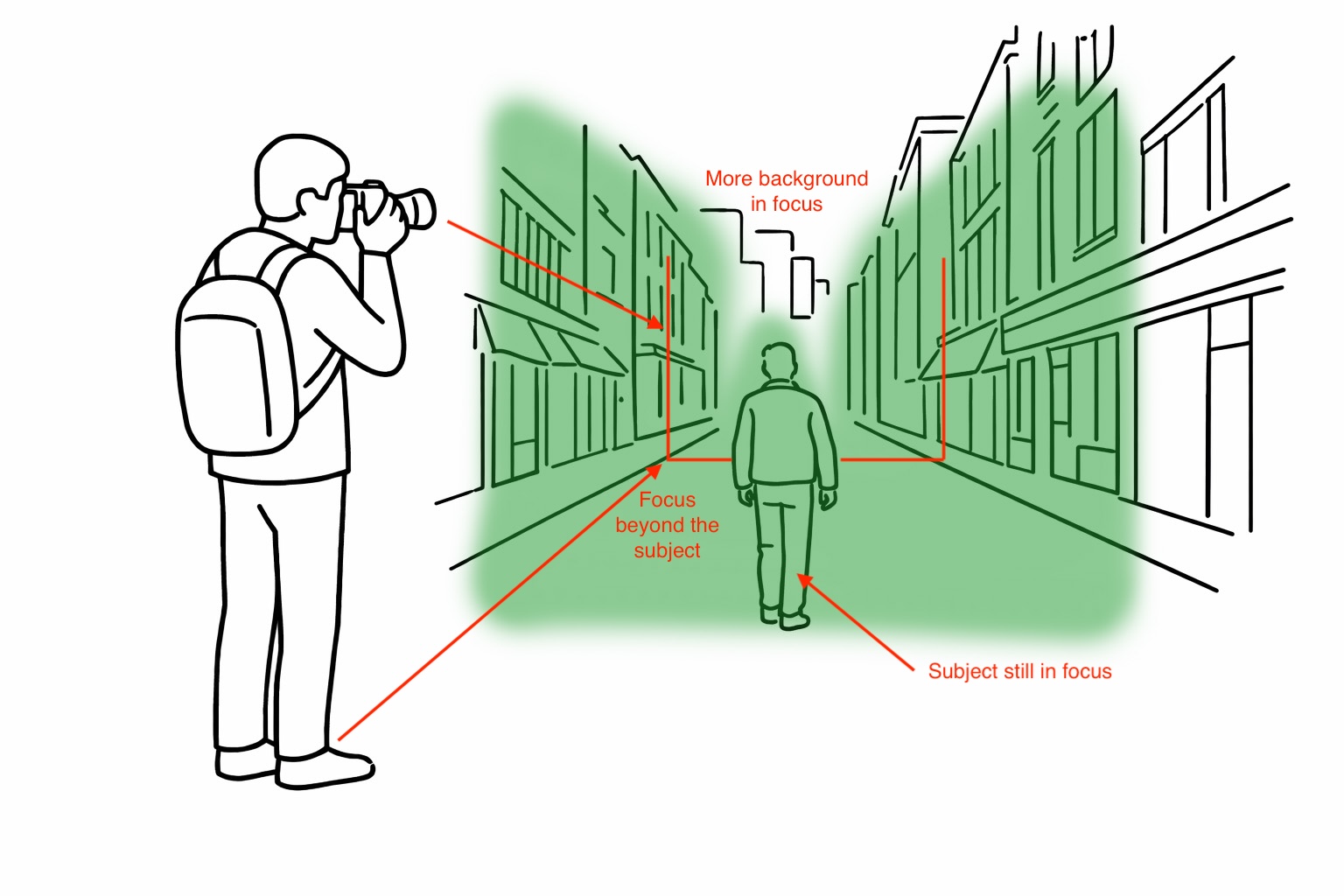
For example, a street scene may include foreground markings, mid-ground activity, and background buildings that define the character of the location. If focus is placed on a person in the middle distance, sharpness may extend forward into the foreground where it adds little, while background elements fall slightly out of focus.
By placing focus further into the scene, it is often possible to keep the main subject acceptably sharp while extending clarity deeper into the frame. The foreground may lose some sharpness, but if it is not visually important, that sharpness was not contributing meaningfully to the image.
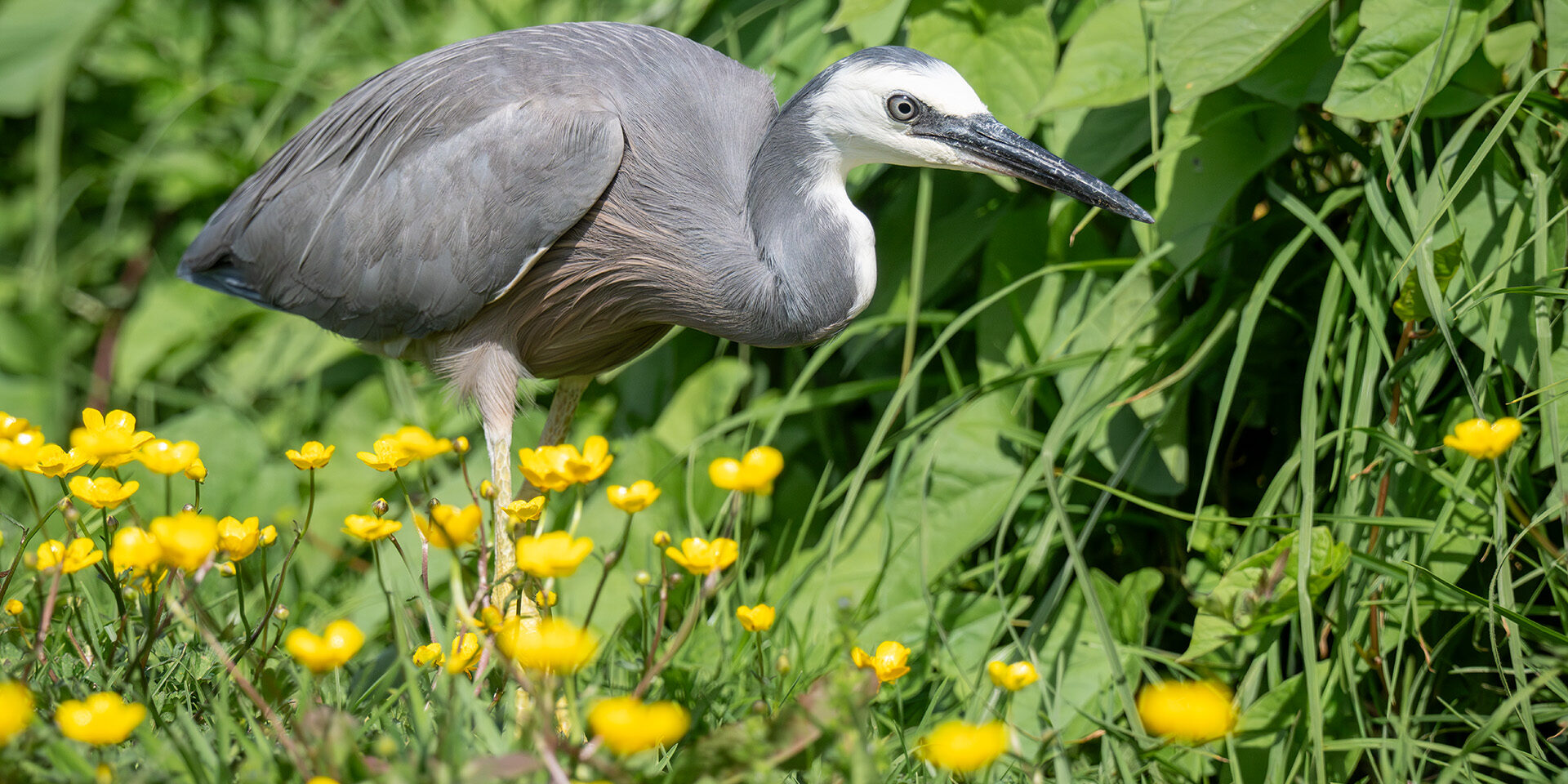
Wildlife photography presents similar considerations. When an animal is photographed within its environment, focusing exactly on the animal may result in a sharp subject against a softer background that provides important context. In some cases, placing focus slightly beyond the animal yields a better balance between subject clarity and environmental detail.
These decisions are situational rather than rule-based. The important point is that focus placement can be adjusted to serve the image, rather than being fixed on the most obvious subject by default.
Wasted focus
Optimised focus
Long-distance scenes: landscapes, horizons, and the moon
Long-distance scenes are where wasted focus becomes most evident.
When photographing landscapes, many photographers are advised to focus at the horizon or to focus “one third into the scene.” These suggestions are often followed without understanding why they sometimes work.
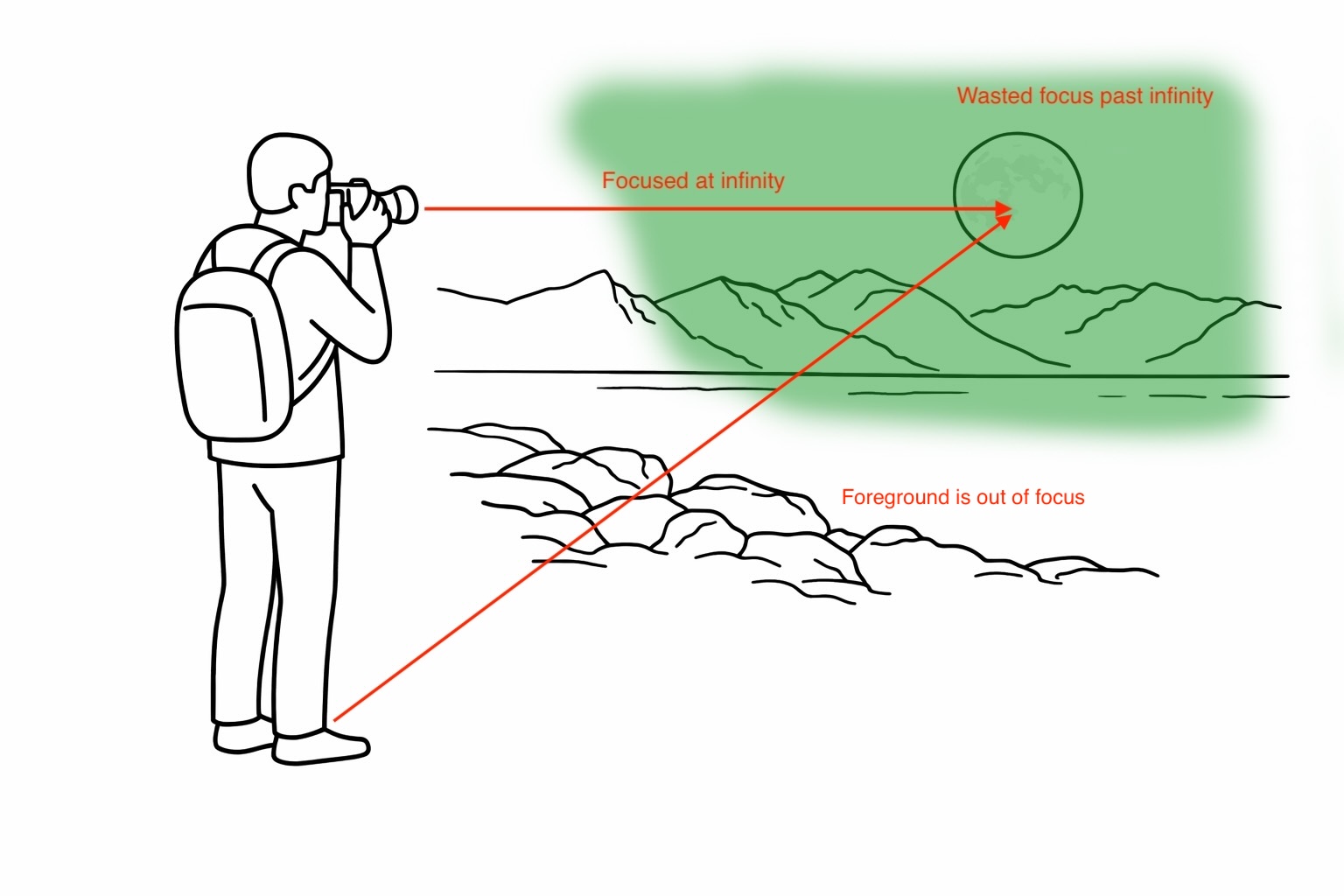
The underlying issue is that focusing at infinity places a significant portion of the sharpness zone beyond the furthest visible objects. That sharpness cannot contribute to the image, because there is nothing there to render.
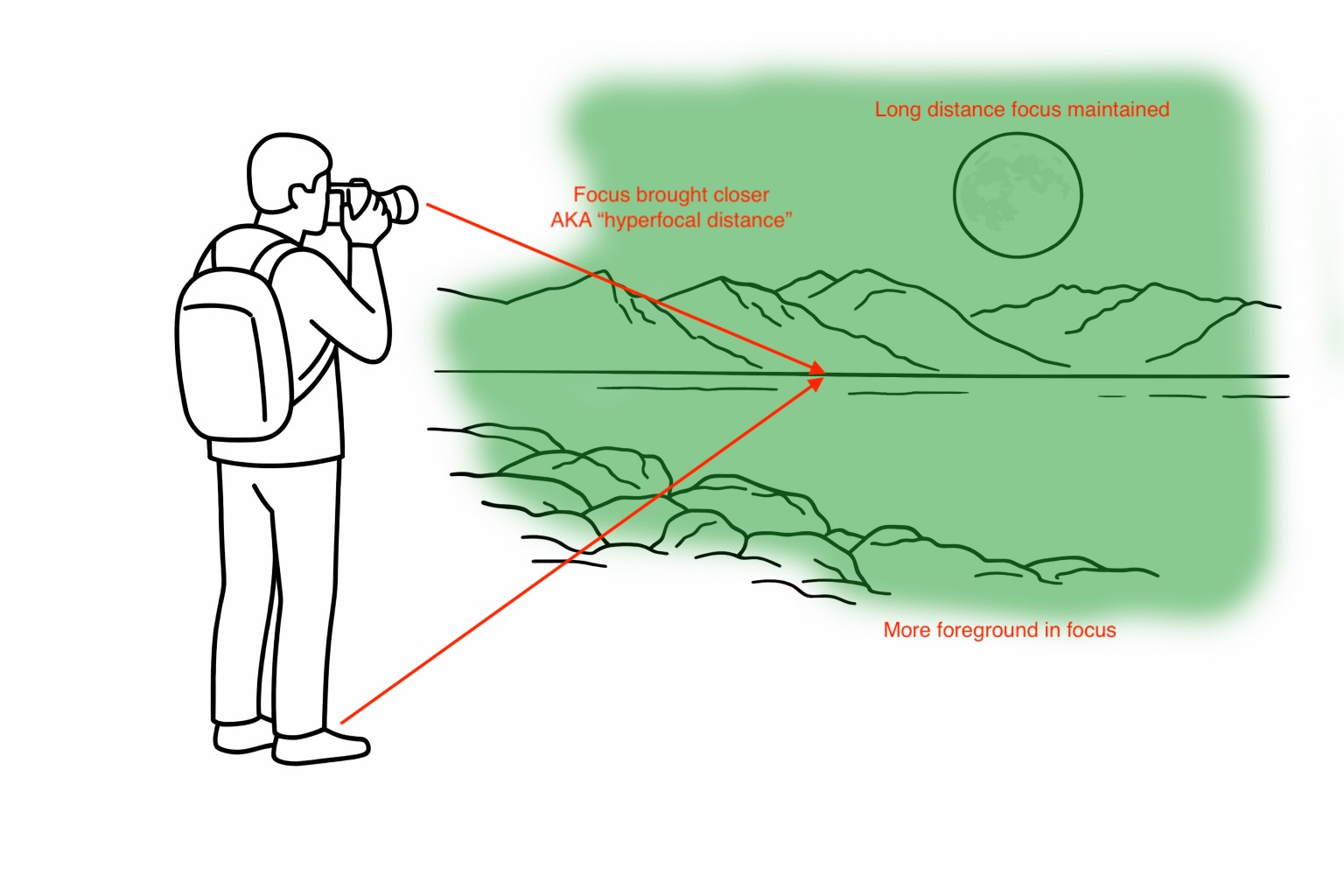
By placing focus closer than infinity, the sharpness zone is shifted forward into the scene. This allows distant elements to remain sharp while extending acceptable focus toward the foreground.
This approach is particularly useful when the image includes both near and far elements, such as rocks leading into a distant coastline or fields stretching toward a horizon. If focus is placed too far away, foreground elements soften unnecessarily. If focus is placed too close, distant elements lose clarity.
The same principle applies when photographing the moon as part of a wider scene. The moon itself is effectively at infinity, but the landscape beneath it is not. Focusing purely for the moon may waste sharpness beyond it while reducing clarity in the foreground or mid-ground.
Placing focus more deliberately allows the available sharpness to be used where it contributes most to the image.
Wasted focus
Optimised focus
Depth of field without calculation
Depth of field is often introduced through technical explanations that emphasise precision and calculation. While these tools are useful, they are not required for effective focus placement in most situations.
A practical understanding is sufficient: stopping down increases the size of the sharpness zone, but does not determine where that zone sits. Focus placement determines that.
If you increase depth of field but continue to place focus without intention, you simply waste more sharpness across a wider range.
One effective way to build intuition is to experiment deliberately. Photograph the same scene at a fixed aperture, but vary focus distance slightly from frame to frame. Reviewing these images reveals how sharpness moves through the scene and how different placements affect the final result.
This kind of experimentation develops practical understanding without requiring memorisation of distances or formulas.
Practical habits to reduce wasted focus
Avoiding wasted focus does not require complex techniques or specialised equipment. A few simple habits are often sufficient.
Before focusing, take a moment to identify which parts of the scene matter visually. Consider whether the foreground, subject, and background all need to be sharp, or whether some areas can tolerate softness.
Be willing to focus past the most obvious subject when the scene supports it. This can feel counterintuitive at first, but it is often effective.
Review images critically, paying attention to where sharpness appears across the frame rather than only on the main subject. Over time, patterns emerge that inform better decisions in the field.
Finally, accept that sharpness is a perceptual concept. Images do not need to be optically perfect everywhere to be effective. Using sharpness where it matters is usually more important than maximising it everywhere.
Why this matters with modern cameras
Modern cameras and lenses offer extremely high resolving power. This increases the potential quality of images, but it also makes uneven sharpness distribution more visible.
High-resolution sensors reveal when sharpness has been allocated to unimportant areas at the expense of meaningful ones. In this sense, better equipment rewards more deliberate focus placement.
Thinking in terms of wasted focus aligns well with this reality. It treats sharpness as a finite resource to be allocated thoughtfully, rather than as an automatic byproduct of stopping down or upgrading gear.
Technical stuff
If you got this far in the article and still really really want to get technical, here’s a tip:
All of the above examples depend on focal length, aperture, sensor resolution and how personally picky you are about sharpness. You can either experiment with your own gear to get to understand how it all fits together, OR you can use a tool like PhotoPills (mobile application).
You can get PhotoPills for Android, or iPhone.
This application gives some mean tools to calculate DoF and Hyperfocal Distance for every conceivable lens and aperture combination.
Closing perspective
Focusing on the subject is often sufficient, but it is not always optimal. Every photograph involves choices about where limited resources are applied, and sharpness is one of those resources.
By recognising when sharpness is being wasted, and by placing focus with intention rather than habit, photographers can often improve image coherence without changing equipment or settings.
The next time you focus, consider not only what you are focusing on, but where the sharpness will fall as a result. That small shift in perspective is often enough to produce more deliberate and effective photographs.
The question is simple, and worth asking regularly:
Are you wasting focus?
Key Takeaways:
What does “wasting focus” mean in practical terms?
It means placing focus in a way that allocates your zone of acceptable sharpness to areas that don’t matter, while important parts of the frame fall just outside that zone. Focus becomes a resource-allocation choice, not a binary sharp/not-sharp decision.
If I focus on the subject, why might the photo still feel inefficiently sharp?
Because focusing on the obvious subject can push usable sharpness into the wrong places. Foreground detail may be razor sharp even if it adds nothing, while background or contextual elements that carry meaning soften slightly due to where the sharpness zone sits.
What’s the mindset shift this article argues for?
Move from “What should I focus on?” to “Where should the sharpness be placed?” The second question recognises that sharpness occupies a range, and that small changes in focus distance can improve how clarity is distributed through the scene.
How does this apply to close-range photos of people or pets?
At close distances, depth of field is shallow, so focus feels fragile. The idea isn’t to abandon eye focus, but to recognise that “acceptable sharpness” can be enough, and that slight focus placement changes (often with a small stop-down) can spread sharpness across more important facial features.
Why is focusing at infinity often wasteful in landscapes and long-distance scenes?
Because focusing at infinity puts a significant portion of the sharpness zone beyond the furthest visible objects, where it can’t contribute to the image. Placing focus closer shifts that zone forward so distant elements stay sharp while more of the scene (including nearer elements) becomes acceptably sharp.