



Did you know that Aperture f-stops are a Maths Thing?
Most photographers learn aperture as a ranking: f/2 is “wide”, f/8 is “narrow”, and smaller numbers mean more light. What often never gets explained is that the numbers themselves already contain that information. They are not arbitrary labels. They are measurements. And once you see what they measure, the whole system becomes much less mysterious.
At its core, an f-number is a fraction, not a size.
The formal definition is simple:
- f-number = focal length ÷ aperture diameter
That single sentence explains almost everything that feels counter-intuitive about aperture.
Take a 50 mm lens.
- At f/2, the aperture diameter is 50 ÷ 2 = a 25 mm “hole”.
- At f/8, the aperture diameter is 50 ÷ 8 = a 6.25 mm “hole”.
So when we say “f/2 is larger than f/8”, we are not talking about the number. We are talking about the hole. The number tells you how many times smaller the opening is than the focal length. Larger divisor, smaller opening.
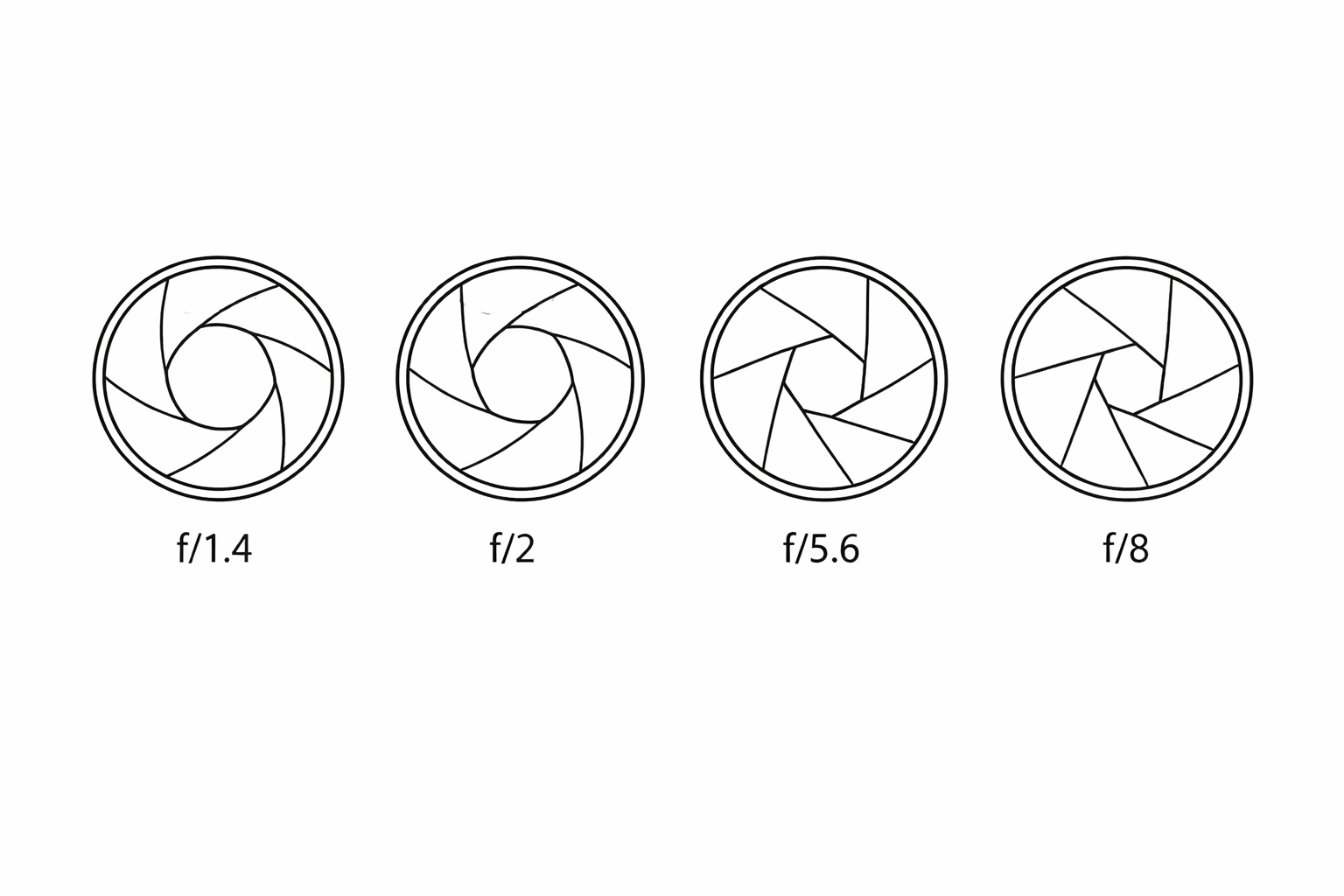
This also explains why aperture values are comparable across lenses. f/4 on a 24 mm lens and f/4 on a 200 mm lens produce the same exposure, even though the physical apertures are wildly different sizes. The ratio is the same, so the light intensity reaching the sensor is the same.
Once you accept that f-numbers are ratios, not absolute sizes, the backwards-looking numbering stops being backwards at all.
Now for the second question that experienced photographers often carry quietly for years:
Why those numbers? Why 1.4, 2, 2.8, 4, 5.6? Why not nice round steps?
The answer lives in geometry and maths, not photography.
Light entering a lens is controlled by the area of the aperture, not its diameter. Area scales with the square of the radius. That matters because exposure stops are defined as doubling or halving the amount of light.
To halve the light, you must halve the area, not the diameter.
Here’s the key step:
If you reduce the diameter of a circle by a factor of √2 (the “square root” of 2, approximately 1.414), its area halves.
That is why the aperture sequence looks the way it does.
Each full stop multiplies the f-number by √2:
1 → 1.4 → 2 → 2.8 → 4 → 5.6 → 8 → 11 → 16 → 22 → 32
Each step reduces the aperture diameter by √2, which reduces the area by 2, which halves the light.
The numbers are not “weird”. They are mathematically exact, just visually unfamiliar.
If you draw an f/2 aperture as a circle, then draw an f/2.8 aperture with a diameter reduced by √2, and then f/4 reduced again by √2, the areas step down cleanly: half, half again, half again. The numbers are doing bookkeeping for the physics.
Lenses sometimes use slightly different markings as their first aperture (f/3.5 or f/6.3). Those are approximations or design compromises. The underlying logic is still area-based light control.
You may also have seen other numbers in between. Say: 1.8, 3.5, 6.3, 13, 19, and 27. Those represent half-stop instead of full-stop differences between the numbers before and after them.
There is a subtle but important implication here for how photographers think about exposure. Aperture is often described as “how wide the lens is open”, but that language encourages a mental model based on diameter. Exposure does not care about diameter directly. It cares about how much surface is available for light to pass through.
That’s why going from f/1.4 to f/2 is not a small change. It’s a full stop. You are halving the light. The physical opening doesn’t look like it halves, because our eyes judge diameter poorly, but the maths is unforgiving.
Here’s the actual maths:
The “true” aperture number at f/1.4 is actually the square root of 2 = 1.41421… (rounded) that’s too long to write on the lens, so simplified it’s written just as 1.4, but I’ll use 1.414 in the maths below.
Now when halving the light, we multiply the current aperture number by this 1. 414 like this:
- f/1.4 (or just “1.414”) x 1. 414 = 2, because the square root of 2, multiplied by the square root of 2, = 2. The new aperture to gain half the light, is now f/2.
To halve the light again, we take 2 and multiply again by 1.414:
- f/2 (or just “2”) x 1.414 = 2.828 (rounded on the lens to 2.8 or written as f/2.8).
We can keep going like this to get the whole sequence.
This is also why depth of field behaves the way it does. Depth of field is not driven by f-number in isolation; it is driven by entrance pupil size relative to subject distance. The f-number encodes that relationship indirectly. Again, it is geometry doing the work, not a photographic convention.
For beginners, this reframing can be liberating. It replaces memorisation (“smaller number = bigger hole”) with understanding (“this number tells me the ratio of focal length to opening”). For experienced photographers, it often resolves a long-standing discomfort: the feeling that the system works, but never quite made sense.
This Demystification is worth addressing.
Some people assume the f-number sequence was designed for convenience and later justified mathematically. In reality, it’s the other way around. Early optical engineers measured apertures physically, observed exposure changes empirically, and formalised the ratios because they worked. Photography inherited a mathematical system that already existed in optics.
Nothing about aperture numbering is arbitrary. It just happens to be rooted in square roots and circles rather than in integers and linear scales.
Once you see that, the numbers stop being strange. They become precise. And precision, not simplicity, is what photography has always relied on.
Perfect geometry does not matter in practice.
Everything above has assumed a circular aperture, because circles make the maths clean and explain the logic of the f-number system clearly. Real photographic lenses rarely have truly circular apertures once they are stopped down.
Most lenses use a set of overlapping aperture blades to form the opening. Depending on the lens, this opening may be a hexagon, septagon, octagon, or some higher-sided polygon. Many modern lenses round the edges of these blades to approximate a circle more closely, but it is still an approximation, not a geometric ideal.
From a light-gathering perspective, this does not matter at all.
Exposure is determined by the effective area of the opening, not by its exact shape. A six-sided aperture with the same area as a circle will pass essentially the same amount of light. The f-number remains valid because it describes the ratio between focal length and effective aperture size, not a requirement for circular perfection.
How aperture blades affect the image:
Where aperture shape does matter is in image artefacts, not exposure:
- Out-of-focus highlights reflect the aperture shape, producing polygonal bokeh instead of round discs.
- Diffraction patterns at small apertures can be influenced by blade count and blade shape.
- Starbursts around point light sources are a direct result of blade geometry.
These effects are aesthetic and optical, not exposure-critical. They change how the image looks, not how much light reaches the sensor.
This distinction is useful because it reinforces the real role of f-numbers. The aperture scale is not describing a mechanical object with perfect geometry. It is describing a functional outcome: how much light the lens transmits relative to its focal length. The maths assumes circles because circles are the simplest way to express that relationship, not because lenses must physically behave that way.
In other words, the f-number system survives imperfect hardware because it was never about shape in the first place. It was about ratios.
Ready to get more technical?
There is one more quiet abstraction hiding inside the f-number definition, and it explains why the system remains reliable even when lens construction becomes complex.
The “aperture diameter” in the f-number equation is not a physical measurement you can take with callipers.
It refers to the entrance pupil.
The entrance pupil is the optical image of the aperture as seen from the front of the lens, after the light has already been bent by the front optical groups. In many lenses, especially telephotos, retrofocus wide-angles, and modern mirrorless designs, the physical aperture blades sit deep inside the lens, far from the front element. What matters for exposure is not where the blades are, or even how large they physically are, but how large they appear to incoming light.
This is why two lenses set to the same f-number can have very different internal constructions and still transmit the same amount of light (ignoring transmission losses, which are handled separately by T-stops). The f-number is tied to the entrance pupil’s effective diameter relative to focal length, not to any single mechanical component.
This also explains why the earlier caveats about shape matter so little. The entrance pupil is already an abstraction: a projected opening shaped by multiple lens elements. Whether the physical aperture is a hexagon or an octagon is secondary. What the light “sees” is an effective opening with a measurable area, and that area determines exposure.
At this point, the structure of the aperture system should feel less like a mechanical scale and more like a normalisation system. f-numbers exist to make exposure predictable across lenses of different focal lengths, designs, and constructions. They work precisely because they abstract away the messy physical details.
Seen this way, the entire aperture scale is not about blades, holes, or even circles. It is about ratios that remain stable in the presence of imperfection. The maths describes an ideal. The optics approximate it well enough that the system holds.
And that, ultimately, is why the numbers look strange but behave so reliably.